Potomac-area residents who hike and paddle the C&O Canal and Great Falls corridors have been on edge after three beaver attacks at nearby state parks in less than a month. But a state furbearer biologist says beavers are the wrong animal to worry about.
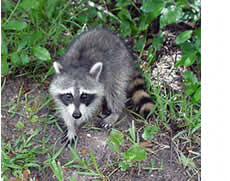
Joshua Tabora, a furbearer biologist with the Maryland Department of Natural Resources, told WTOP on Aug. 17 that the real "vector species" carrying rabies in Maryland are raccoons, striped skunks, foxes and bats. Raccoons alone account for 50–60% of all confirmed rabies cases in the state in any given year, according to Maryland Department of Health data going back to 2018.
Beavers, by contrast, are almost never carriers. The last documented rabid beavers in Maryland before this summer were in 2021, when two cases made up less than 2% of that year's total. From 2022 through 2025, roughly 900 animals tested positive statewide. None were beavers.
The beaver that attacked a 13-year-old swimmer at Cunningham Falls State Park on July 26 tested positive for raccoon-type rabies, Tabora said, meaning it likely caught the virus from a raccoon rather than from another beaver. Aaron Hall, Beaver Corps program director with the Beaver Institute, told WUSA9 on Aug. 18 that "beavers are not transmitting rabies between each other."
State officials say there is no indication of a rabies outbreak in either Frederick or Montgomery County. Montgomery County averages about two or three rabies cases per year, according to county spokesperson Scott Peterson. Public health experts told Bethesda Magazine there is no greater risk to public safety this summer compared to previous years.
What to actually watch for
Tabora wants to dispel what he called "an old wives' tale": that seeing a raccoon, skunk or fox during daylight automatically means the animal is rabid.
"There really aren't any animals in Maryland that I would be alarmed to see at any time of day," Tabora told WTOP. "So just because you see a raccoon for example, out and active at noon does not mean by itself that that animal is rabid."
The real warning signs: an animal walking in circles, foaming at the mouth, showing disorientation, acting unusually aggressive or friendly, or approaching people without fear.
Safety rules for the trail
Tabora recommends keeping at least 25 yards between yourself and any wild animal. If the animal is displaying possible neurological symptoms, increase that distance to 50 yards. Keep dogs on leashes near water and in state parks.
If bitten or scratched, wash the wound with soap and water for 15 minutes and seek medical attention immediately. Post-exposure vaccination is highly effective because the virus moves slowly through the nervous system. Untreated rabies, however, is almost always fatal.
Closures around Seneca Creek near Berryville Road, including surrounding trails and parking lots, remain in place until further notice as of Friday, Aug. 21.
Report suspected rabid or sick wildlife to the Maryland Wildlife Hot Line: 410-260-8540.